+7 812 740—76—87
Version for the visually impaired
Submit a request
all brands
21996-76
21996-76
Cold-rolled heat-treated steel strip GOST 21996-76 in coils at the manufacturer's warehouse.

GOST 21996-76 Heat-treated cold-rolled steel strip

Cold-rolled heat-treated steel strip, manufactured in accordance with requirements GOST 21996-76, is a high strength and resilient structural material. The main difference between this category of metal products is the final heat treatment (hardening and tempering), which gives the metal a given level of hardness and tensile strength. This standard applies to tape designed for the manufacture of springs, measuring tools and various machine parts that require increased wear resistance.

Unlike hardened tape, heat-treated products have a more uniform microstructure and stable mechanical properties, which eliminate the need for additional hardening of finished products by consumers, reducing the risk of warping and manufacturing defects.

Chemical composition

High-quality carbon structural and tool steels are used to produce the tape in accordance with GOST 21996-76. The choice of steel grade directly depends on the required performance characteristics of the final product. According to the standard, the following brands are used:

  • Carbon structural steels: 50, 60, 65, 70 (according to GOST 1050). They provide good ductility combined with high strength after heat treatment.
  • Carbon tool steels: U7, U8, U8A, U9, U9A, U10, U10A (according to GOST 1435). These grades have a higher carbon content, which makes it possible to achieve the maximum hardness required for cutting and measuring tools.

Strict adherence to the mass fraction of carbon, silicon and manganese, as well as the restriction of the content of harmful impurities (sulfur and phosphorus), ensures the stability of the physical and mechanical properties of the tape.

Physical and mechanical properties

Cold-rolled steel strip is classified according to several parameters that determine its physical condition:

  1. Strength groups: The standard distinguishes three main groups — 1P, 2P and 3P. Each group has clearly defined values of temporary resistance to rupture (⁄v÷c) and hardness.
  2. Manufacturing accuracy:
    • Normal accuracy;
    • Increased thickness accuracy (T);
    • Increased width accuracy.
  3. Surface type: Depending on the heat treatment conditions, the surface may be light yellow (C), brown (C) or gray (dark gray).
  4. Sickle shape and flatness: To ensure accuracy in automated stamping lines, the tape is tested for deviations from straightness.

The mechanical properties allow the belt to withstand significant cyclic loads, maintaining its shape and not being subject to fatigue damage.

Production features

The technological process at the St. Petersburg Precision Alloy Plant is organized according to a full quality control cycle. Production includes:

  • Cold rolling: It allows you to achieve minimum thickness tolerances (up to hundreds of a millimeter) and high surface quality.
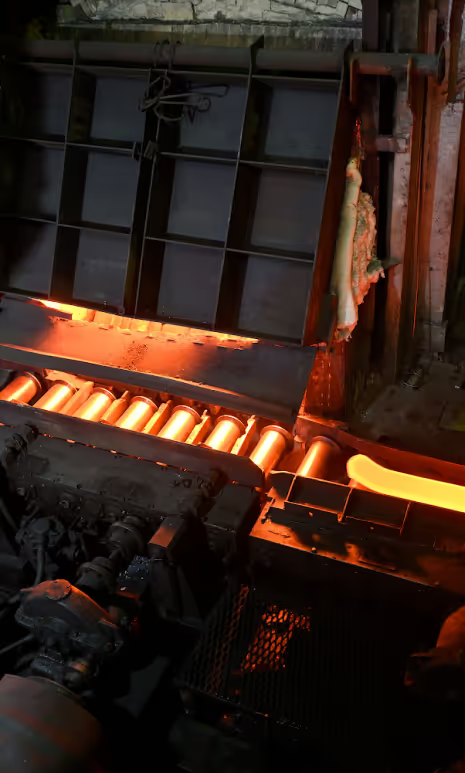
  • Heat treatment in a protective environment: The use of special protective gases in pass-through furnaces prevents decarburization of the steel surface layer and the formation of scale. This is critical for maintaining the strength characteristics of thin tapes.
  • Hardening and tempering: The belt passes through cooling media, followed by uniform heating to relieve internal stresses, which provides a specified strength group.

Areas of application

Due to the combination of high hardness and elasticity, cold-rolled steel strip is used in the most critical units:

  • Instrument engineering: Manufacture of flat springs, spring contacts and sensor elements.
  • Tool production: Measuring tapes, saw blades, spatulas, knives, blades.
  • Automotive industry: Compressor valve plates, spring clips, clamps, brake system parts.
  • Textile industry: Details of needles and birds of looms.

Heat treatment

The heat treatment process in accordance with GOST 21996-76 is continuous. Heating for hardening is carried out to temperatures of 780—850°C (depending on the steel grade), followed by rapid cooling in oil or water-polymer media. Subsequent tempering at temperatures of 300—480°C makes it possible to transform the martensite structure into tempering troostite, which ensures the unique spring properties of the material.

Decoding the marking

To choose the right material, it is necessary to understand the structure of the symbol.
Example: 0.3x15-C-1P-T-70 tape GOST 21996-76

  • 0.3 — thickness (mm);
  • 15 — width (mm);
  • C — surface with colors of rustiness;
  • 1P — the first strength group;
  • T — increased thickness accuracy;
  • 70 — steel grade 70.

Types of delivery and forms of products

The tape is supplied in tightly wound rolls. Each roll considers of one piece of tape. To protect against corrosion, the products are covered with a layer of preservative lubricant and packed with moisture-proof materials.

  • Thickness range: from 0.05 mm to 2.50 mm.
  • Width range: from 4 mm to 250 mm.

Buy from the manufacturer: St. Petersburg Precision Alloy Plant

If you need guaranteed quality and compliance with all parameters GOST 21996-76, cold-rolled steel strip buy from the manufacturer — this is the optimal solution. The St. Petersburg Precision Alloy Plant offers favorable terms of cooperation for industrial enterprises.

Our advantages:

  1. Direct quality control: We check each batch for compliance with chemical composition and mechanical properties in our own accredited laboratory.
  2. Own production: Possibility to order tapes with individual tolerances and specific heat treatment requirements.
  3. Efficiency: Availability of stock in popular sizes and fast production times to order.
  4. Technical support: Our experts will help you choose the optimal steel grade and strength group for your needs.

When ordering products from us, you get a reliable partner and high-quality steel tape that will ensure the durability and reliability of your products.
Other steel grades